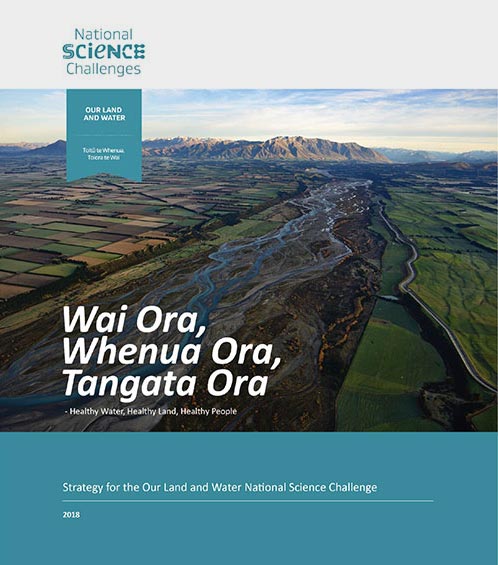
 View Our Strategy Document 2019 – 2024
August 30, 2024
Our Land and Water has now ended.
Our mission was to preserve the most fundamental treasures of Aotearoa – its land and water – while producing value from those same treasures.

Resource Finder
Use one, some or all the filters below to explore our resources, tools & research.
Know what you are looking for? Type below
Or, use our filtered search by selecting as little or as much as you like.
Showing 1 - 9 of 994 results

Guidance
Heartland Strong: How Rural New Zealand can Change and Thrive
This book, based on years of research, shows how, and provides useful insights into, the ongoing process of change in rural communities and the resources…

This project has produced


Presentation
Perspectives on how Market Forces and Regulation are Shaping the Future of NZ Farming
Weed Science Society of America, February 2019, New Orleans USA

Technical Report
Measurement of neon in groundwaters for quantification of denitrification in aquifers
Nitrate is the most pervasive contaminant in New Zealand’s groundwaters. Thus, understanding and managing nitrogen loads through New Zealand’s aquifers is vital for maintaining the…

Journal Article
Temporal Changes in Cd Sorption and Plant Bioavailability in Compost-Amended Soils
The application of Cd-contaminated phosphate fertiliser has enriched concentrations of this non-essential element in many agricultural soils. Consequently, concentrations of the metal in some agricultural…

Interactive Tool
Labour and Land-use Regional Model for Aotearoa
The Labour and Land-use Regional Model for Aotearoa helps track labour availability and costs. Being aware of regional workforce capacity will contribute to understanding the suitability…

Video
Integrating Multiple Stressors and Lake Resilience into Lake Management Frameworks
Session: Drivers of Change Presentation: Evolving the Paradigm: Integrating Multiple Stressors and Lake Resilience into Lake Management Frameworks Speakers: Marc Schallenberg
Technical Report
Implications of sediment for fish in the lower Wairoa River, Hawke’s Bay
The Wairoa River and its tributaries in Hawke’s Bay are vital for mahinga kai and hold high cultural value for the iwi and hapū of…

Summary
Creating Value for New Zealand Agri-food Exports: Moving from supply chains to value chains
This Research Briefing presents results of research that identifies nine key elements of successful agri-food value chains from New Zealand. The research team worked with…
Where are we conducting our research?
This interactive map shows the location of all our research projects to help connect you with the research happening in your catchment.
Hover over regions and click to see key information about the projects.
Our Key Collaborators